
“I’m gonna cum”. These are the words any barebacker or bug chaser loves to hear when they’re getting fucked and if you’re like me, you want the guy fucking you to cum deep inside you, without pulling out before he cums. You have probably been ejaculating for a long time, but have you ever stopped to think about the makeup of cum, such as what’s in it, where it comes from and why we like it so much? I think about cum a lot, because it’s the most intense part of a sexual experience, the moment when everything you’ve been working hard to produce comes to life through a warm and sticky explosion. It seems as though cum has this elusive power over our minds that makes us need it constantly, to the point where we can never get enough of it.
Cum is often referred to as many things, with the more formal names being sperm or semen, but did you know that sperm and semen are not the same thing? Sperm is inside semen, but semen is not inside sperm, and that’s because sperm is a part of the fluids that make up semen. Sperm is not the only thing that’s inside semen, you’ll also find citric acid, free amino acids, fructose, enzymes, phosphorylcholine, prostaglandin, potassium and zinc. Like anything in life, things can be more complicated under the surface, or in this case, within the fluids. Cum is also referred to in slang as baby batter, bone sauce, jism, jizz, love juice, man jam, man juice, man milk, nut, seed, snake gravy, splooge, spunk and a whole bunch of other quirky names, which often sound hot.
In the same way dicks come in all different shapes and sizes, cum is also not the same. When I was in my first year of high school, some kid asked me what colour cum is in front of a bunch of other students. They all looked at me as my face went red, because I couldn’t answer the question, as I didn’t even know what he was talking about at the time. I hadn’t reached puberty yet, but now I do know the answer and I can even double check whenever I want by producing a sample on demand. If you were asked what colour semen is, your answer would most likely be white. This is generally correct, but to be precise, a normal sample of semen has a grey-opalescent appearance based on various fluids forming the semen, but the colour can vary due to a few different factors.
Most of us probably know that cum also has a fishy odour, so don’t panic if your cum smells a bit fishy. Maybe that’s where the word “semen” comes from, based on “seamen” fish reference? Haha. Cum can also smell a bit like chlorine, as the scent can vary, just like the appearance. If you’re wondering what a normal amount of semen volume per ejaculation is, the scientific answer is around 2 to 3 millilitres (it can be more or less), which is around a teaspoon’s worth of fluid and approximately 10% of this fluid consists of sperm. There are other things that exist within seminal fluids, including HIV. During sexual intercourse, the free-floating virus and HIV-infected leukocytes bathing in the seminal fluids can flow into the body of another person and if HIV enters their bloodstream, the virus quickly gets to work by looking for CD4 cells to infect.
If you’re wondering where cum comes from, the first answer you might come up with is probably your dick or perhaps even your balls. You are technically correct if you answered dick, because this is what dispenses cum from your body, but if your answer relied solely on balls (or nuts) being where cum comes from, then your answer is only about five percent correct. It’s hot thinking about cum being produced in your balls, because they can look so sexy dangling between your legs, but semen is produced in various parts of your body, as the fluids comes together to work their magic and do their thing.
How Semen Gets Produced by Your Body
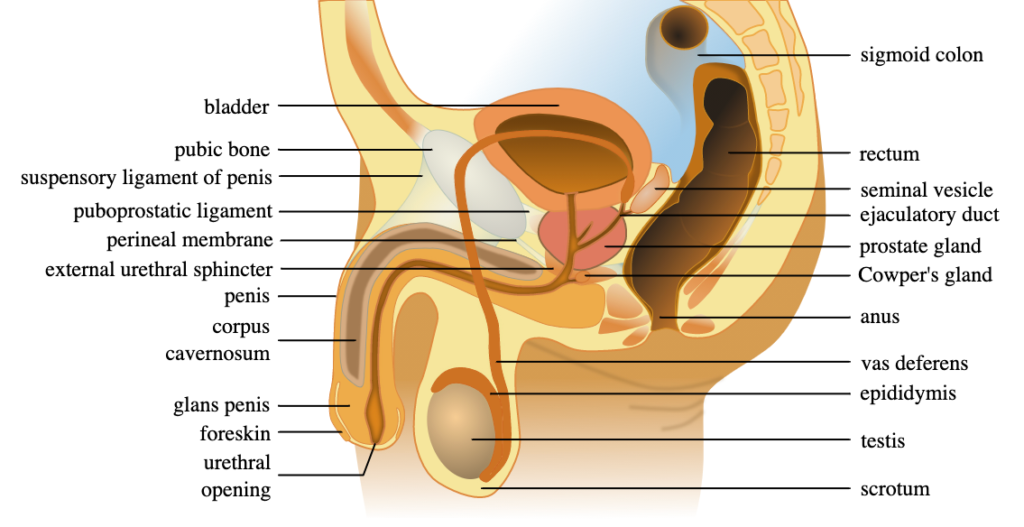
- 46 to 80 percent of the fluid in semen is produced by the seminal vesicles. The seminal vesicles are sac-like glands that sit behind the bladder.
- 13 to 33 percent is produced by the prostate gland. The prostate is a gland that surrounds the neck of the bladder and urethra and secretes an alkaline fluid that also helps propel semen from the penis.
- 5 percent is produced by the testicles and epididymis. The testicles are two small organs that sit inside the scrotum and the epididymis is a long tube located near each testicle that moves the sperm to the vas deferens.
- 2 to 5 percent is produced by the bulbourethral glands. These glands branch off the internal wall of the urethra, which is the passageway for urine and semen.
If you want to know what cum tastes like, then why not try some yourself the next time you ejaculate and you’ll find that it doesn’t taste too bad at all. The slightly sweet taste comes from the high fructose content, but of the taste can vary from person to person and what you eat can affect the taste, but it can also taste bitter too. For example, drinking lots of water can make cum taste better, plus cinnamon and pineapple are believed to make it taste better as well. According to my research, the pH range should be 7.2 to 7.8, which is the normal pH of the body, but if the pH is lower than 7.2, there may be a low sperm count or higher than 7.8 can indicate a urinary tract infection.
If you were to put semen under the microscope, sperm would look like tadpoles or swimmers that have an important job to do when it comes to reproduction. Sperm have places to go when it comes to procreating, but without the help of semen to carry them to these places, sperm would just swim around in circles, which would lead to some major population reduction issues. The body is smart enough to ensure things move in the right direction, just like we need lubricant to ensure our poles can glide in and out of holes with each thrust while we’re getting fucked or fucking someone to keep things moving along nicely.
So now that we know a bit more about cum, let’s take a look at cum from a bug chasing perspective, since that’s what this website is all about. Cum is extremely fascinating to bug chasers, because it’s an integral part of the conversion process, as the bodily fluids can carry and introduce the virus to our body through sexual intercourse. Getting fucked is a lot of fun, so when a guy has an orgasm and cums inside us, his ejaculate fluids enter our body in an intimate, yet powerful way. For many barebackers and bug chasers alike, breeding is a part of the sexual experience that can lead to a life changing outcome.
For many barebackers, the terms “breeding” or “cream pie” are great ways to describe cum entering our body’s backdoor, with breeding usually defined as the top cumming inside the bottom without pulling out and a cream pie usually refers to the top pushing his cummy dick inside the bottom after he has ejaculated, which leaves a creamy mess as his dick slides back inside (like what would happen if you stick your finger into a cream pie). Bug chasers often refer to guys who ejaculate HIV-negative cum as “shooting blanks”, because their loads do not contain HIV, so their cum isn’t able to provide them with life-changing qualities.
Bug chasers are looking for loads that can be described as charged, toxic or viral, with some guys referring to HIV-infected cum as poison or venom, like from a scorpion, snake, spider or wasp. Cum is the same bodily fluid, whether it’s infected with HIV or not, but the difference in thinking between barebackers and bug chasers, is that we see cum differently, because we’re looking for cum that offers a detectable viral load and not cum that is either negative or undetectable, which makes detectable cum more valuable. In a reproduction comparison, semen is needed so the sperm within semen have the ability to fertilise an egg to create life through pregnancy, with bug chasers needing the virus within semen to change their life through infection, with the virus entering their body becoming a new life as it replicates and grows stronger.
Further Reading:
- What Your Semen Says About Your Health – https://www.verywellhealth.com/facts-about-semen-an-indication-of-health-status-2328524
Featured Photo: Karin Henseler from Pixabay
Article ID: CC015
Version Control: 1.0 – October 16, 2021: Original article published.